Is minimalism killing design?
Updated: May 20, 2025

Lifeless and boring. This is what minimalism has caused our world to look like. Logos that were once filled with joy and character have now been demoted to be uniform and soulless. The trend of 'modernising' logos and designs has wrecked havoc and ripped any slither of hope and bliss we once had. All we can do now is look back at past, now vintage, designs and reminisce the perfectly detailed creations. Image 1 above visually shows the decline in design which struck Mercedes-Benz in the space of less than a century. This blog post will focus on minimalism and how this trendy movement has slaughtered real design- with key architectural examples.
Well. I sincerely apologise for that slightly harsh introduction. I completely understand that design is subjective and that minimalism does (somehow) have fans all around the world. For some individuals, minimalism is more impactful as it leaves room for audience interpretation (Ferro, I., T., 2024). It conveys the designs as a constant work-in-progress. which creates a healthy mindset of always striving for the best. In some ways, this helps to elevate designs and ensure only the best for the final product. However, this produces a continuous and seemingly never-ending cycle where the design will never be finished or even maintain a core structure of ideas. According to Ferro (2024), in architecture, minimalism starves the location of both culture and individuality, causing these designs to feel lifeless and uniform. This, too, may seen harsh, however compared to previous design movements- such as: Art Deco, Gothic, Arts and Crafts and post-modernism- minimalism does indeed seem too simple and tamed.
For me, there are no boundaries in design, and good design understands this by showcasing a balance of creativity and logic.
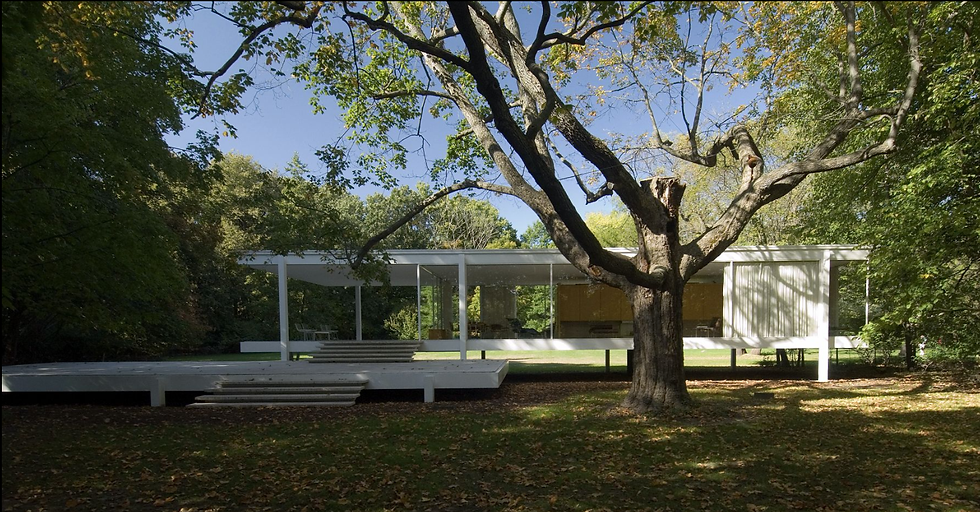
The Farnsworth House (pictured above- Image 2), designed by Mies Van Der Rohe, is a prime example of minimalism in a structural sense. It features an open plan composition and emphasizes light and seamless flow between living, sleeping and dining (Sunwoo, I., 2006). The white-painted steel and glass provide clean lines and an open appearance, furthermore, the free-standing core creates an uncluttered space and focuses on the minimalistic aesthetic (Sunwoo, I., 2006). These features showcase Farnsworth House as a simple and uniform space which focuses on the clean aesthetic. However, for me, this provides no character or story behind the space and doesn't particularly aid or add to the surrounding environment.

On the other hand, pictured above (Image 3), St. Pauls Cathedral in London, designed by Sir Christopher Wren, showcases character and detailed artisanal work. The space has a story behind it- after being redesigned and rebuilt after burning down during the Great Fire of London in 1666- and used this to evolve as a design and structural piece of history. It was built from Portland Stone, and consists of composite and corinthian columns for the upper and lower of the exterior (Fuller-Walker, 1874). The 60ft dome, which towers 215ft above the ground also adds character and detail to the building- which executes elegant lightness and supreme beauty (Fuller-Walker, 1874).
Although both designs are iconic in their own respective design movements- one remains timeless (even after nearly four centuries of the current design), while the other blends in with other structures in its design style. Detailed architecture and designs, like St. Pauls Cathedral, are known worldwide due to their elegant details and innate beauty. Whereas minimalistic architecture and design, like Farnsworth House, seem to fall in line and are barely recognised by everyday people.
References:
Dhiman, G., (2023, March 11). Mercedes-Benz brand evolution. Brandwick. https://brandwick.com/mercedes-benz-brand-evolution/
Ferro, I., T. (2024). Minimalism and the Death of Detail. The Harvard Crimson. https://www.thecrimson.com/article/2024/10/15/minimalism-maximalism-design-detail/#:~:text=There%20has%20been%20a%20debate,leaves%20room%20for%20audience%20interpretation.
Fuller-Walker. (1874). St. Paul’s Cathedral. The Aldine, 7(10), 206–206. https://doi.org/10.2307/20636885
Holttum, R. (2007). St. Paul’s Cathedral. JSTOR. https://jstor.org/stable/community.12288471
Klee, J,. E. (2007). Farnsworth House. JSTOR. https://jstor.org/stable/community.14920568
Sunwoo, I. (2006). Taming the Farnsworth House. Thresholds, 31, 66–75. http://www.jstor.org/stable/43876275



Comments